There are moments when we may become aware of the passage of time, or rather, the passage of our lives in time. Our birthdays often prompt such awareness. And New Year’s Eve as well, as we mark the passing of one year to the next. In those moments we may be filled with both a sense of hope and a healthy panic. The moments when we are reminded of our mortality may not be “happy” moments, but they are certainly moments of grace.
So now that we find ourselves in 2026, what is it we need to do?
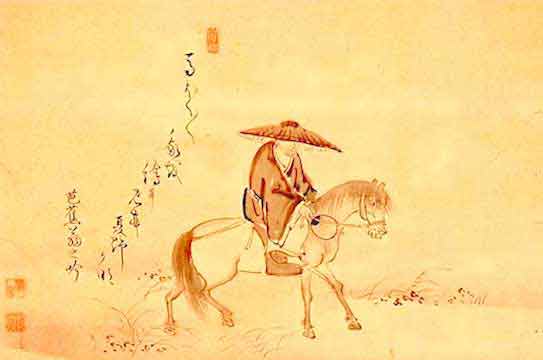
Zen monks like Ikkyu and Ryokan were wanderers – at least for a portion of their lives. They abandoned worldly values such as wealth, fame or power and one could say they lived a life of purposelessness – simply wandering from place to place. Here is one of Ryokan’s poems:
Truly, I love this life of seclusion.
Carrying my staff, I walk toward a friend’s cottage.
The trees in his garden, soaked by the evening rain,
Reflect the cool, clear autumnal sky.
The owner’s dog comes to greet me;
Chrysanthemums bloom along the fence.
These people have the same spirit as the ancients;
An earthen wall marks their separation from the world.
In the house volumes of poetry are piled on the floor.
Abandoning worldliness, I often come to this tranquil place –
The spirit here is the spirit of Zen.
Ryokan wrote this poem about 200 years ago. And while cottages, friendly dogs and chrysanthemums still populate the world, I skeptically find myself modifying the lines a bit to reflect more modern times:
These people have a slightly different spirit from the ancients; A high gated fence marks their separation from the world. A high speed internet line provides their connection to the world. In the house, volumes of poetry can be found within a small tablet and iphone which sit charging on the dining room table.
Tranquility can still be found. Separation from the world . . . not so much.
The haiku poet, Matsuo Basho, was also a wanderer, yet not necessarily without purpose. His travels are chronicled in his well-known book, The Narrow Road to the Interior. Though he wandered, his purpose was to write haiku poems. Here is a sample:
Speechless before
These budding green leaves
In blazing sunlight.
It’s easy to romanticize a wandering life. No bills to pay. No grass to cut. No shopping lists. But it’s not all budding green leaves and blooming Chrysanthemums. Here’s another of Basho’s poems:
Eaten alive by lice and fleas
Now the horse
Beside my pillow pees.
Ryokan, too, is not immune to discomfort and despair:
In a dilapidated three-room hut
I’ve grown old and tired;
This winter cold is the worst I’ve suffered through.
I sip thin gruel, waiting for the freezing night to pass.
Can I last until spring finally arrives?
How will I survive the chill?
Even meditation helps no longer;
Nothing left to do but compose poems in memory
of deceased friends.
To wander was to experience every facet of life: the fragrance of honeysuckle, the itchiness of flea bites, a hidden waterfall in the forest, loneliness, meeting a fellow traveler, missing your family, enjoying the breeze, getting lost. Joy and discomfort intermingle and boredom occasionally stops by for tea.
I wandered for a time in Japan when I was young. I found myself on a spiritual pilgrimage to explore three sacred mountains: Mt. Hiei, Mt. Yoshino, and Mt. Koya. It was an adventure – a time of not knowing where I would sleep the next night. I visited Buddhist temples and caught a glimpse of the marathon monks circumambulating Mt. Hiei. I discovered thick, heavy chains attached to a cliff used by the legendary Yamabushi. They would allegedly hang from the chains and chant in order to show their deep religious faith.
But let’s get back to our mortality and the current date. If you are lucky enough to stay alive for the rest of this year, what’s really important? If you have no destination or goal, then enjoy your wanderings and savor the whole range of experience you will have. But if you are trying to get someplace, then by all means point yourself in that direction and get going. Don’t be blown off course by a gust of wind or deterred by a bridge which collapsed last week. Discover a purpose that’s worthy of your life. Find what you need to do and do it. If you have the good fortune of knowing what you’re here for, then you owe it to the rest of us to honor that wisdom.
When Buckminster Fuller was about to jump off a bridge and commit suicide in 1927 he had an epiphany – one that kept him alive and turned him in a different direction. He felt that time had stopped and then he heard a voice:
“You do not have the right to eliminate yourself. You do not belong to you. You belong to the Universe. Your significance will remain forever obscure to you, but you may assume that you are fulfilling your role if you apply yourself to converting your experiences to the highest advantage of others.”
Fuller went on to live another 55 years and became a professor, inventor, architect, and designer of the geodesic dome. He was awarded 28 U.S. patents and won several awards including the Presidential Medal of Freedom. But you’re not Buckminster Fuller, are you? And you’re not Ryokan or Basho. Nor are you Jayzee or Meryl Streep. So who are you? And what is it you you need to do?
**************************************************************************************************
Gregg Krech will be leading a 30 day online program, LIVING ON PURPOSE, beginning on January 8, 2026. Gregg is the author of 5 books about Japanese Psychology, including The Art of Taking Action. CLICK HERE to learn more about the program and to register.
Tags: Procrastination Purpose Thirty Thousand Days