


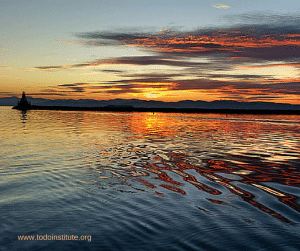
Linda and I took a ferry ride this afternoon, crossing Lake Champlain from Vermont to the New York side. The sky was a mix of blue and assorted clouds all heading in the opposite direction of the boat. A ferry ride is often seen as a transition – a way of getting to a destination.
When Linda was still my girlfriend, she lived on Staten Island and we would take the ferry, along with a thousand other people who had destinations in Manhattan. But when we’re taking the ferry across Lake Champlain, the whole point is the ride itself. There’s not much on the other side, in Essex, NY, a small town with a restaurant, an ice cream shop and a small park where you can sit and watch the ferries come and go. We chose to ride the ferry today because we simply wanted to ride the ferry.
We took our car and our puppy, Betty, with us on the boat. All the cars are sandwiched into four different lines with almost no space in between. Once the ferry leaves, you can turn off the car, get out, walk around the ferry and admire the views in all directions. If you look west, you see the multi-layered peaks of the Adirondack mountains. If you look east, back to Vermont, you see the picturesque, rounded, not-quite-as-high peaks of the Green mountains.
As we stood on the ferry, leaning carefully on the railing, we were making no effort beyond moving our eyes and our heads. Our movement over the water, our breathing, our heartbeats were all proceeding without any effort on our part. We were free to just observe the beauty of the world around us. As the ferry approached the dock at Essex it slowed down and I proceeded to walk back to my car and prepare for departure. On my short walk I passed about six cars and I couldn’t help but notice that each car had at least one person looking at their phone.
Arriving in the World
Today is my birthday. I’ve completed 71 years since I found my way into this world. Several times a year I calculate how much time I have left. I do that by calculating the number of days I have lived and subtracting that number from 30,000 – an estimate of how many days we each may live. If I lived in one of the Blue Zones like Okinawa, Japan or Sardinia, Italy, my number would be slightly higher.
The number of days I have left goes down every time I check. I’m noticing a trend here.
Lest you think this is a morbid exercise, it’s not. It’s my periodic wake up call. When I lived, briefly, in a Zen center in Japan, the head monk would walk behind us during meditation and hit us on the shoulder with a stick. It stung, just enough to provide a jolt of energy. When he finished, I would bow and communicate my thanks. I was grateful to be awakened. I didn’t want to sleep through meditation. And I don’t want to sleep through the remaining days of my life. I’m grateful to see my mortality forecast right in front of me. There are things I need to do before I die. The urgency of that number works in my favor.
I take no credit for being born. That goes to my mom and dad, both of whom died in the past twelve years. Thanks to them I am able to watch a chickadee open a sunflower seed at the birdfeeder and taste a fresh blueberry right from a blueberry bush. One of my favorite passages is from Bill Bryson’s book, A Short History of Nearly Everything,
“Consider the fact that for 3.8 billion years, a period of time older than the Earth’s mountains, rivers and oceans, every one of your forebears on both sides has been attractive enough to find a mate, healthy enough to reproduce, and sufficiently blessed by fate and circumstances to live long enough to do so.”
So I guess my presence here goes back a bit further than my mom and dad. But of all my ancestors, I knew my parents the best. They not only brought me into this world, but they kept me alive for a while until they could pass on that responsibility to the larger world. I am still “kept” alive, for without the support of other people, objects and forms of energy, I have no capacity to keep myself alive, at least for very long. I’m already on life support. I always have been.
Bad Luck and Troubles
In the song, Everyday I Have the Blues by B.B. King, there is this lyric . . .
“Talk about bad luck and troubles, well you know I had my share.”
Most of us, upon reflection, which we may tend to do on birthdays, can recall many of the challenges and difficulties we faced since our childhoods. Some, in retrospect, were common challenges in the arenas of relationships, health and money. Others truly lived up to the meaning of “tragedy.” But many of these events often pushed us past the edge of our comfort zone, to a place that was truly difficult to cope with.
But you did cope (if you’re reading this) and it may be that you came away from your difficulties having learned something and, perhaps, coming out the other end stronger or wiser. The author-philosopher, Nassim Nicholas Taleb, calls this idea “antifragility.”
Steven Colbert, former host of The Late Show, had to face a tragic event when he was a ten year-old child. His father and two brothers were killed in a plane crash. One moment he had a full family including parents and siblings. And the next moment it was just him and his mother. In an interview he described how he was completely shattered by the event. But he went on to say,
“It’s a gift to exist, and with existence comes suffering. There’s no escaping that. I don’t want it to have happened. I want it to not have happened. But if you are grateful for your life—which I think is a positive thing to do, not everybody is, and I am not always but it’s the most positive thing to do—then you have to be grateful for all of it. You can’t pick and choose what you’re grateful for.”
But, of course, we do pick and choose what we’re grateful for. I’m grateful for a ferry ride on the lake on a sunny summer day. I’m not grateful for my computer crashing or discovering a large bleach stain on my shirt.
Yet, when we step back from our life we are more likely to see it as a package. You’re either grateful for it or you’re not. When I ride my bike over the rolling hills of Vermont it involves both ups and downs. In life, we prefer the “ups.” In biking, I prefer the “downs.” But the ups and downs make each other possible. One doesn’t exist without the other. It’s a package deal
When I reflect on the past 71 years, I truly feel grateful for my life – the whole package. I wouldn’t trade places with anyone in the world, because in doing so I would have to give up everything I cherish and have cherished since I was born. I would have to give up my wife, who I adore. And my two daughters, who I love deeply. I’d have to give up my 33 years of time with my three dogs, three of the loveliest creatures in the world. I’d have to give up game-winning basketball shots I made at the buzzer (there weren’t that many, but I still wouldn’t want to give them up). I’d have to give up what I learned from spiritual teachers like Thich Nhat Hanh and Rev. Kenryu Tsuji. And trips to Japan and Italy. And playing legendary music for audiences at vineyards and festivals. As a package, nobody has a life they could offer me for which I would trade my own.
So with 4,057 days left, my mind gravitates toward action and reflection – the yin and yang of life. Action, because I am conscious of time, my own mortality, and important things I want to do before I die. Reflection, because it is through reflection that we open the doorway to gratitude.
Of course, this number, 4057, is unlikely to be accurate. But that’s irrelevant. What’s important is the recognition that there is a number. There is an actual number of days I have left to live. That’s what wakes me up to my life.
My only brother died ten days ago, unexpectedly. He was three years younger than me. I’m saddened, of course, by his departure. His death is another reminder to use my remaining time well. What does that mean, “to use my time well”? Well, that’s a question we should all be asking ourselves every day. And the answer to that question isn’t a thought or idea or principle. The answer is what people should see when they watch how we live.
If my life was a football or basketball game, I would be in the fourth and final quarter of that game. In sports, the final minutes of the game is when the players try to summon up all their energy to play fully, without holding anything back. But in real life, the fourth quarter is often when we slow down. Decades of life, with its challenges and struggles can wear us down. We sleep more, we dance less. We lean into security and away from adventure.
I prefer the sport analogy. As I finish the game, I’d like to use my remaining time to summon up my energy and fall in love again – with my wife, with my dog, with my daughters, with the chickadees that visit our deck every morning and with playing music and ferry rides on the lake. That’s my aspiration. And I expect to fail quite a bit.
In John McQuiston’s interpretation of the Rules of St. Benedict, written in the sixth century:
It is for us
To train our hearts
To live in grace,
To sacrifice our self-centered desires,
To find the peace without want
Without seeking it for ourselves,
And when we fail,
To begin again each day.





)